NEUCHATEL, Switzerland - Monday, 11. December 2023
In
the Largest Study of ORi to Date, of 554 Patients, Researchers
Conclude: “ORi Can Provide Useful Information on Arterial Oxygenation
Even During One-Lung Ventilation”
(BUSINESS WIRE) -- Masimo
(NASDAQ: MASI) today announced the findings of a retrospective study
published in the Journal of Anesthesia in which Dr. Yu Jeong Bang and
colleagues at the Samsung Medical Center, Sungkyunkwan University School
of Medicine, in Seoul, South Korea, investigated the association of
Masimo ORi™ and the arterial partial pressure of oxygen (PaO2) in 554
patients who underwent non-cardiac thoracic surgery during one-lung
ventilation (OLV), making this study the largest to date on ORi. The
researchers found that ORi values “were significantly correlated with
PaO2 measured simultaneously” and that ORi “could provide useful
information on arterial oxygenation even during one-lung ventilation.”1
Noninvasive,
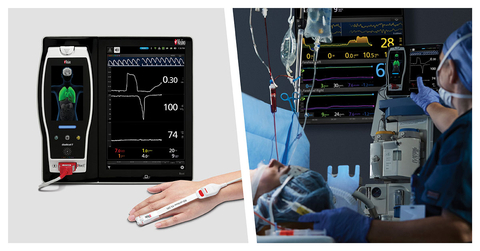
continuous Masimo ORi provides continuous, real-time insight into the
oxygenation of hemoglobin in the moderate hyperoxic range (PaO2 > 100
and ≤ 250 mmHg) to be used alongside arterial blood gas analyses, which
have the drawbacks of being invasive, intermittent, and delayed. ORi is
trended continuously with SpO2 as a unit-less index between 0.00 and
1.00 to extend the visibility of the patient oxygenation beyond SpO2
under supplemental oxygen. By convention, SpO2 is limited to an upper
limit of 100%, but oxygenation is not limited and can rise into
hyperoxia (higher than normal oxygenation state) when supplemental
oxygen is administered. ORi provides clinicians with additional
visibility, as a complement to SpO2 monitoring with Masimo SET® pulse
oximetry, into when oxygenation is increased into, or decreased out of,
moderate hyperoxia, in real time.
Noting the importance of
striving to prevent hyperoxemia and hypoxemia especially during surgery
requiring OLV, because of the risk of pulmonary complications, the
researchers sought to evaluate a noninvasive, continuous method of
predicting imminent over- or under-oxygenation to overcome the drawbacks
of invasive blood gas analysis alone, using Masimo ORi. To evaluate
ORi’s performance, they analyzed data collected from 554 patients who
underwent non-cardiac elective thoracic surgery requiring OLV between
January 1 and December 31, 2022 at a tertiary hospital in South Korea.
During anesthesia, ORi was monitored using Masimo RD rainbow SET® Pulse
CO-Oximetry sensors, and blood gas analysis was performed 15 minutes
after OLV was initiated. The researchers’ primary endpoint was the
association between simultaneous ORi and PaO2 values. They also sought
to identify risk factors for PaO2 < 150 mmHg, based on their clinical
experience that most patients with PaO2 > 150 mmHg in this scenario
rarely show hypoxemia.
The researchers found a linear correlation
between ORi and PaO2 measured simultaneously. Using linear regression
analysis, they found there was a statistically significant positive
relationship between ORi and PaO2 measured 15 minutes after OLV
initiation (r2 = 0.5752, p < 0.001). Using receiver-operated curve
(ROC) analysis, they identified an optimal cut-off ORi value of 0.27 to
detect PaO2 ≥ 150 mmHg during OLV (area under the ROC curve of 0.96, 95%
confidence interval of 0.94 – 0.98, sensitivity 0.909, specificity
0.932). Of the 11 potential predictors for PaO2 < 150 mmHg identified
by the researchers, ORi was highly predictive (odds ratio 0.001, p <
0.001).
The researchers concluded, “ORi values during one-lung
ventilation were significantly correlated with PaO2 measured
simultaneously. Therefore, the ORi monitor can provide useful
information for estimating the PaO2 value even during one-lung
ventilation.”
In the U.S., ORi has been granted a De Novo by the
FDA to be used in patients undergoing surgery as an adjunct to SpO2 for
increased monitoring resolution of elevated hemoglobin oxygen saturation
levels (e.g., due to administration of supplemental oxygen). The ORi
feature is indicated for the monitoring of hemoglobin oxygen saturation
levels in patients 18 years and older (adults and transitional
adolescents) on supplemental oxygen during no-motion conditions
perioperatively in hospital environments.
@Masimo | #Masimo
About Masimo
Masimo
(NASDAQ: MASI) is a global medical technology company that develops and
produces a wide array of industry-leading monitoring technologies,
including innovative measurements, sensors, patient monitors, and
automation and connectivity solutions. In addition, Masimo Consumer
Audio is home to eight legendary audio brands, including Bowers &
Wilkins, Denon, Marantz, and Polk Audio. Our mission is to improve life,
improve patient outcomes, and reduce the cost of care. Masimo SET®
Measure-through Motion and Low Perfusion™ pulse oximetry, introduced in
1995, has been shown in over 100 independent and objective studies to
outperform other pulse oximetry technologies.2 Masimo SET® has also been
shown to help clinicians reduce severe retinopathy of prematurity in
neonates,3 improve CCHD screening in newborns4 and, when used for
continuous monitoring with Masimo Patient SafetyNet™ in post-surgical
wards, reduce rapid response team activations, ICU transfers, and
costs.5-8 Masimo SET® is estimated to be used on more than 200 million
patients in leading hospitals and other healthcare settings around the
world,9 and is the primary pulse oximetry at 9 of the top 10 hospitals
as ranked in the 2022-23 U.S. News and World Report Best Hospitals Honor
Roll.10 In 2005, Masimo introduced rainbow® Pulse CO-Oximetry
technology, allowing noninvasive and continuous monitoring of blood
constituents that previously could only be measured invasively,
including total hemoglobin (SpHb®), oxygen content (SpOC™),
carboxyhemoglobin (SpCO®), methemoglobin (SpMet®), Pleth Variability
Index (PVi®), RPVi™ (rainbow® PVi), and Oxygen Reserve Index (ORi™). In
2013, Masimo introduced the Root® Patient Monitoring and Connectivity
Platform, built from the ground up to be as flexible and expandable as
possible to facilitate the addition of other Masimo and third-party
monitoring technologies; key Masimo additions include Next Generation
SedLine® Brain Function Monitoring, O3® Regional Oximetry, and ISA™
Capnography with NomoLine® sampling lines. Masimo’s family of continuous
and spot-check monitoring Pulse CO-Oximeters® includes devices designed
for use in a variety of clinical and non-clinical scenarios, including
tetherless, wearable technology, such as Radius-7®, Radius PPG®, and
Radius VSM™, portable devices like Rad-67®, fingertip pulse oximeters
like MightySat® Rx, and devices available for use both in the hospital
and at home, such as Rad-97® and Masimo W1®. Masimo hospital and home
automation and connectivity solutions are centered around the Masimo
Hospital Automation™ platform, and include Iris® Gateway, iSirona™,
Patient SafetyNet, Replica®, Halo ION®, UniView®, UniView :60™, and
Masimo SafetyNet®. Its growing portfolio of health and wellness
solutions includes Radius Tº®, Masimo W1, and Masimo Stork™. Additional
information about Masimo and its products may be found at
www.masimo.com. Published clinical studies on Masimo products can be
found at www.masimo.com/evidence/featured-studies/feature/.
RPVi
has not received FDA 510(k) clearance and is not available for sale in
the United States. The use of the trademark Patient SafetyNet is under
license from University HealthSystem Consortium.
References
Bang Y, Seong Y, Jeong H. Association between Oxygen Reserve index nd
arterial partial pressure of oxygen during one-lung ventilation: a
retrospective cohort study. J Anesth. 7 Sept 2023. DOI:
10.1007/s00540-023-03259-4
Published clinical studies on
pulse oximetry and the benefits of Masimo SET® can be found on our
website at http://www.masimo.com. Comparative studies include
independent and objective studies which are comprised of abstracts
presented at scientific meetings and peer-reviewed journal articles.
Castillo A et al. Prevention of Retinopathy of Prematurity in Preterm
Infants through Changes in Clinical Practice and SpO2 Technology. Acta
Paediatr. 2011 Feb;100(2):188-92.
de-Wahl Granelli A et al.
Impact of pulse oximetry screening on the detection of duct dependent
congenital heart disease: a Swedish prospective screening study in
39,821 newborns. BMJ. 2009;Jan 8;338.
Taenzer A et al. Impact
of pulse oximetry surveillance on rescue events and intensive care unit
transfers: a before-and-after concurrence study. Anesthesiology.
2010:112(2):282-287.
Taenzer A et al. Postoperative
Monitoring – The Dartmouth Experience. Anesthesia Patient Safety
Foundation Newsletter. Spring-Summer 2012.
McGrath S et al.
Surveillance Monitoring Management for General Care Units: Strategy,
Design, and Implementation. The Joint Commission Journal on Quality and
Patient Safety. 2016 Jul;42(7):293-302.
McGrath S et al.
Inpatient Respiratory Arrest Associated With Sedative and Analgesic
Medications: Impact of Continuous Monitoring on Patient Mortality and
Severe Morbidity. J Patient Saf. 2020 14 Mar. DOI:
10.1097/PTS.0000000000000696.
Estimate: Masimo data on file.
http://health.usnews.com/health-care/best-hospitals/articles/best-hospitals-honor-roll-and-overview.
Forward-Looking Statements
This
press release includes forward-looking statements as defined in Section
27A of the Securities Act of 1933 and Section 21E of the Securities
Exchange Act of 1934, in connection with the Private Securities
Litigation Reform Act of 1995. These forward-looking statements include,
among others, statements regarding the potential effectiveness of
Masimo ORi™. These forward-looking statements are based on current
expectations about future events affecting us and are subject to risks
and uncertainties, all of which are difficult to predict and many of
which are beyond our control and could cause our actual results to
differ materially and adversely from those expressed in our
forward-looking statements as a result of various risk factors,
including, but not limited to: risks related to our assumptions
regarding the repeatability of clinical results; risks related to our
belief that Masimo's unique noninvasive measurement technologies,
including Masimo ORi, contribute to positive clinical outcomes and
patient safety; risks that the researchers’ conclusions and findings may
be inaccurate; risks related to our belief that Masimo noninvasive
medical breakthroughs provide cost-effective solutions and unique
advantages; risks related to COVID-19; as well as other factors
discussed in the "Risk Factors" section of our most recent reports filed
with the Securities and Exchange Commission ("SEC"), which may be
obtained for free at the SEC's website at www.sec.gov. Although we
believe that the expectations reflected in our forward-looking
statements are reasonable, we do not know whether our expectations will
prove correct. All forward-looking statements included in this press
release are expressly qualified in their entirety by the foregoing
cautionary statements. You are cautioned not to place undue reliance on
these forward-looking statements, which speak only as of today's date.
We do not undertake any obligation to update, amend or clarify these
statements or the "Risk Factors" contained in our most recent reports
filed with the SEC, whether as a result of new information, future
events or otherwise, except as may be required under the applicable
securities laws.
View source version on businesswire.com: https://www.businesswire.com/news/home/20231210873994/en/
Permalink
https://www.aetoswire.com/en/news/1112202336460
Contacts
Masimo
Evan Lamb
949-396-3376
elamb@masimo.com


No comments:
Post a Comment